Revamp

So I have started in earnest on the quick Hurricane Baby rewrite for July. I am working with the last reading Cheryl gave it and finding new ways to ratchet up the tension throughout. I am on story number 12 so far, and finally ran into one of them I’m not sure I can improve on. But I’m going to keep thinking on it to make sure. I am using Cheryl’s notes to work through problem passages that she pointed out that need either rewriting or cutting.

The story I just went through was a good example of what I am doing. In the last rewrite, I realized that each individual story had three impactful scenes in it, a rising tension one, a big climax, and a third scene leading into the next story in that arc. I just went through the story where Cindi leaves Tommy and realized the third scene was really flat. It didn’t have any stakes for Cindi and Tommy; it was just a memory of Cindi’s. So I made the scene have some more meat to it and added to the stakes of the fight between Cindi and Tommy over his drinking.

Another particular one that Cheryl had commented on was a story told from Rosie’s point of view, and Cheryl felt like it was Wendy’s story to tell. It had been originally in Wendy’s POV, but I wanted it to be in Rosie’s so she could have her say about the events in the book as well. But I hadn’t told a story about her in it. On this rewrite, I made the story about their relationship as sisters. I made it have stakes between them instead of just Rosie finding out about Wendy’s relationship with Judd. Hopefully that gives the story more depth and meaning and makes a better case for Rosie as the narrator.

I’m doing that with every story, checking that the number of scenes is right, that the stakes are high, and that each story is told from the right character’s POV. So we will see how it turns out.

Wish me well–I will need to be sending it back out soon after July to the new places I found to submit to. Here’s to second chances.

Swap

My writing buddy Cheryl sent me back her read of Hurricane Baby: Stories, and her read was much more favorable that I thought it might be. She noted a very few places in the manuscript where she lost track/got tripped up in the narrative, and she thought I could actually cut some places where I was describing actions that didn’t necessarily move the plot forwards–she urged me to focus on the action throughout, which was a nice surprise. She said she really, really loved it, and her favorite character was Tommy Hebert, the one I turned from a peripheral character to a major one –she said his character arc really held her attention.

So now I think I know what to do with it in the next stage of revision, which I am probably going to take up next year (if it doesn’t get picked up by someone before that) after I draft my new project I want to work on. I am going to make each story as individually strong as I can and start sending them out to see if I can publish them in high-profile places and get them some attention. We will see what happens.

Some of the items she mentioned I can fix now before it goes out to anyone else this year–they’ll be quick. And I need to finish reading and reacting to her manuscript before the end of the month. So i am gong to look for some time to finish that before May 30.

i am very glad I did this new swap. I feel more confident about the manuscript’ strengths and know where to fix the weaknesses. So good. Onward and upward!

Ready to Swap Again

I’m on the verge of doing another swap of Hurricane Baby with another writer, this time Cheryl Pappas, who I met through the workshop I attended last summer. She is writing her first novel even as we speak, so I will be beta reading that for her, and she will be reading Hurricane Baby.

I’m not sure what I can actually accomplish by having it read again and revising it again. I may can make it better so it gets accepted at one the eight places left on my list where I haven’t yet sent it. Which is a heck of a tiny margin of error or success, depending on how you look at it.

Or I may can make it better and send it around again in 2030.

That looks like a damn desperate concept when I say it that way.

Or her feedback may convince me to shelve it altogether and start over with my new story idea and just work on that for a while.

Or I may can take the feedback, make each story the best it can be, and try to sell the individual stories around to see if I can get one or three picked up by journals to have a better chance once I start sending it around again.

That sounds more hopeful than giving up. Or simply waiting around after revising.

I guess the moral is: Keep fighting for your work. Even if it means a strategic retreat from time to time. The fight IS the work in that case. So that’s what I’m doing: Fighting.

Honesty in Writing Fiction

Is honesty a concern in writing fiction?

Most people would probably say no. It’s supposed to all be made up. Out of your head. Figments of imagination. If it’s not, then it’s not fiction–it’s nonfiction.

Beginning writers often write about real events that happened to them–and defend themselves when told it’s not plausible by saying, “But that really happened to me!”

So what do we mean when we say we want honesty in fiction?

Well, often what has happened is that the writer has set up a character to be a certain sort of person–honest, villainous, seductive, dogmatic, whatever their defining trait is–and then the writer has those characters do something that readers literally describe as “out of character”. The honest person may lie. The villainous character may rescue a homeless kitten. The seductive character may get to the edge with a seductee and upon finding out she’s married, turn virtuous and say no to sleeping with her.

Often when the reader gets taken out of the story by someone acting “out of character”, it’s because they writer didn’t draw the character as a fully rounded complex individual. I like to write characters where a reader may have no idea what the character might do next–they’re interesting, but often dangerous, just as an unpredictable person might be in “real life”.

Flat characters are actually hard to write about in an interesting way. They may have only one defining trait, and therefore their path is fixed. The honest character will always tell the truth no matter what the consequences. The villainous character would always lie even when there’s no clear benefit to doing so.

Whatever world you create–whether your characters live in the middle of Mississippi or on the edges of the galaxy–readers often want writers to follow the rules the writers create. If a writer builds a world where the atmosphere is unbreathable–until the main character steps foot on it and needs to survive without his spacesuit, which the writer had fail upon atmospheric entry to heighten the dramatic tension–the writer better have a good explanation why that character stays alive that makes sense in the world the writer has created–beyond simply that the writer wants him to survive.

One of the most effective techniques to create dramatic tension around what a character may or may not do is foreshadowing–dropping small hints about how the honest guy is only honest about one aspect of his life but not about another. Another is immediate flashbacking following the character’s uncharacteristic action–where the reader sees what the character did when it was a kid faced with the same type of choice–what did the character do then? Is that character going to make the same choice, or a different one? Why?

Robertson Davies, one of Canada’s leading authors of the twentieth century, once said, “Imagination is a good horse to carry you over the ground, not a flying carpet to set you free from probability.” If a writer’s world follows certain rules, the writer must be honest with the reader as to why the roles are there–and why they get broken. If a character is rounded, complex and human–those rules can be bent a bit– if and only if the writer is sure to point out how said bend serves the story and is not as “out of character” as the reader suspects.

Why Do You Write What You Write?

I’ve struggled with this question now for almost twenty years.

When I wrote fiction in my first stint in graduate school, I took only one fiction workshop class. The stories I wrote there reflected a few preoccupations I had at the time that continue in my writing today–an affinity for love triangles, characters with southern accents, watching the results of a single action as it unfolded across time.

But they were pretty typical for juvenilia, often not-so-loosely based on people I knew and drawn from some of my own circumstances: one story I remember was a what-if of what might have happened if I had not reconciled with my longtime boyfriend, and another was taken almost literally from life from an incident when I was in high school of me trying to defend a kid from being bullied–and how I wished it had turned out. But–a most important distinction–they had happy endings.

Not so with the fiction that spilled out of me after my youngest child was born. Still Waters was so dark and desperate that I scared myself putting it on the page. I really wondered what had happened to me, that I was writing something that could not end happily–ever. I tried. Having Wendy go back to Ray seemed like a soul-death for her, but having her leave Ray for Judd resulted in something even worse–signing up for what could have been hell on earth.

All my fiction has been that way ever since. Very dark moods, gritty plots, morally gray or actively wretched characters. The truly miserable thing is that I couldn’t stand to read such stories written by someone else. I tried reading some books in my freelance career that were classed as Southern Gothic and wound up throwing them against the wall–literally in at least one case. I enjoyed uplifting stories and nonfiction, where I could learn something.

Where did all of this darkness come from?

It was a long time before I faced down the answer. I remembered all the tales my relatives had told of their hardscrabble lives. Every cheating song that played on country radio the summer of 1983 when we didn’t have the money to replace the lightning-struck television and listened to the radio all day, every day. Every divorce among my cousins. Every untimely, early death in my community from drunk-driving teenagers, suicidal housewives, or gun-toting men.

Desperation and sorrow was my birthright and my history. But even through it all, we–my family, myself, my characters–endured. Imperfect solutions to problems stemming from dark secrets–that was my “stuff”.

So I don’t apologize for it anymore. It’s just life. it ends, continues, begins, endures. The cushiest, most stress-free life you can imagine–it still ends. We all have to die. We’re all equal at the edge of the River Styx. I write about people who live because they’re afraid of what happens when they die.

What do you write about?

Playing with ChatGPT

So I decided to be one with the cool kids and see how well ChatGPT worked. I had it do several blog posts “in the style of Julie Liddell Whitehead”.

I was not expecting much, and that’s what I got.

It produces clean copy. But it’s very airy copy. No substance, all glitz. i asked it to write a blog post “about the book Hurricane Baby”. It gave it a glowing review that–oddly enough–sounded a lot like reviews handed out for books on Amazon. No specifics, no details, just airy copy how what a wonderful book it was! (I also got a lot of discussion about all the places that had interviewed me about the book and all the accolades it had won) Pretty good for a book that hasn’t been published yet. 🙂

Apparently it’s been trained to sound authoritative by using a lot of words. I tried getting paragraphs in the style of some other authors (like John Grisham and Anne Lamott) and got much the same results. It would not be hard to imagine it being written by a real person, as long as that person’s last writing class had been Business Communication in college. As far as imitating other authors, it didn’t have much of a range beyond a few big names.

I think what will always distinguish great writing from just good writing is specificity: details. quirky characters who sound like actual people, a sense of place. If you want boilerplate language, I think ChatGPT may can deliver that error-free. But the sense that an actual person is behind the writing? That’s up to us, the writers, to keep our writing fresh and exciting–and real.

Writing Is Hard

Not to sound all fuddy-duddy and get-off-my-lawn-ish, but I don’t think some people understand how hard writing is.

You have to do so many things well to write well.

You have to be able to research your topic. You have to know how to research your topic. You have to be committed to researching your topic, despite all the challenges that may be thrown at you. You can research by reading books, talking to people knowledgeable about the topic, doing internet searches, poring over primary sources and records. And each research method has its own skill set to master before it can be effective.

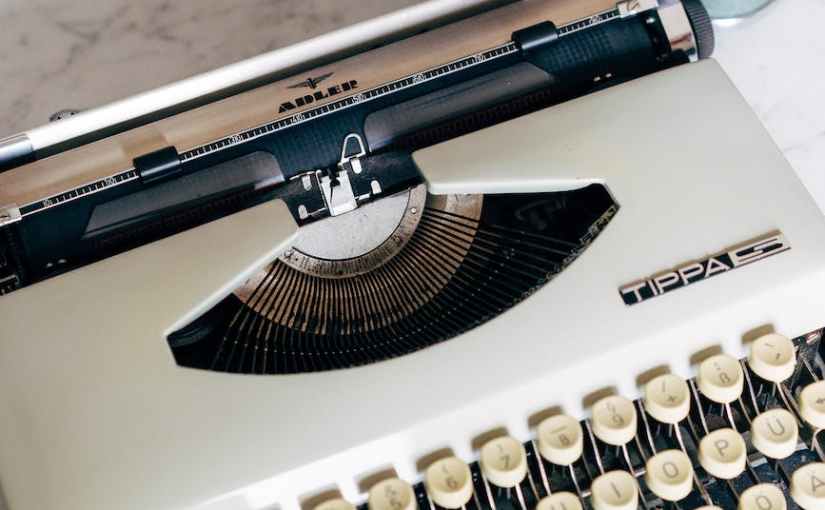
Gone are the days of the copy pencil and paper and two-finger typing on a manual typewriter. Soon the qwerty keyboard may be on its way out the door as well. Adapting to the speeded-up pace of publishing is a must. Adapting to technology is a must. Adapting to your physical environment is a must, whether you work in a dedicated space in your home, or a coffeeshop, or a busy office environment. Writing is a physical act, not for the fainthearted.

You have to be able to recall, synthesize, and highlight information that is important to the reader’s understanding. A plain recitation of the facts is NOT writing. Beguiling, seducing, and entertaining the reader is what writing is all about. Sometimes it feels like you have to trick your reader into understanding what you want to get across; other times you have to trick yourself into believing that anyone cares. The writer’s job is to make them care, even if they aren’t interested.

It’s lonely–writing as a group activity is almost never good writing. It’s isolating–often the writer needs time and space to just think about the work, rather than talking about it to someone or bombarding their consciousness with noise. It’s often excruciating–when the perfect word or turn of phrase is just out of reach of the writer’s mind. It’s alienating–the writer has to believe in themselves when others wonder when the writer is going to give up this obsession and get a job.

But if you show up and do the work, magic can happen. That’s the writer’s payoff–not money, not fame, not bestseller status. The magic of a craft practiced well is the best payoff there is.

Read-Thru

So I didn’t post last night, because I was doing something kind of nerve-wracking.

I sat down and read Hurricane Baby again, all the way through, from start to finish.

It was so gratifying. because the stories held up to scrutiny.

I had wondered if when I read it again, I would discover lots of problems. Continuity problems, poor story construction, tone-deaf dialogue–I was prepared for the worst: that I would see that it really wasn’t in my best interest to publish it.

That’s not what I saw reading it.

Are there places that could be better? Probably. One place in particular I thought I might need to add a scene that is referenced early on but not played out.

Typos? Yep. But not nearly as many as I was afraid of.

But the stories still felt true. I’m sure if someone picks it up, it will need to undergo some revisions. But the stories are there: meaningful, impactful, and oh so human.

That was a good feeling. I wish i could bottle it for when I find myself doubting my skills and talent. Hurricane Baby might not be Great Literature, with capital G and capital L.

But it’s good. And right know, that knowledge is enough.

Doing a Little Research

I read an article recently talking about an illustrator who lost the ability to visualize what he was supposed to be drawing–for him, it happened after he went back to work from a three-week bout of COVID.

Going through the article, I learned a new word: aphantasia.

It means the inability to visualize images in your mind.

I found out that most people are able to “see” imagined images.

Now I have heard all my life about the “mind’s eye”–where you can recall how a person looks or imagine a scene in your mind to relax. I’ve read a lot of literature talking about visualization–imagining the outcome you want, and that imagining preparing you for various scenarios, such a public speaking, etc.

I never knew, however, that most people, when closing their eyes and being asked to visualize something, ACTUALLY SEE SOMETHING. This bit of knowledge was surprising because–

All I see are the backs of my eyelids.

I don’t see ANYTHING when I try to visualize. Nothing. Zip. Zilch. Nada.

Why am I talking about this? Well, it seems that most writers do a bang-up job imagining people, places, and things and are then able to narrate what they see in their mind’s eye, describing their characters, settings, and action.

I have always been told my writing is missing that kind of description. It was something I worked hard to try to do in my writing for graduate school for my MFA, something I tried to learn as a matter of craft.

But now I know it’s a case of my brain, again, being different from other writers’ brains.

I’ve been chewing this insight over for a while.

And right now, I am in a bit of despair about it.

Do I need to give up fiction? And on the hope of succeeding with my fiction? Are readers now so addicted to visual stimuli that if I can’t do this thing, I don’t have a writing future?

What should I do?

Writing Resolutions

I’m not typically much for New Year’s Resolutions. I tend to take a random day out of the year and think over the past year’s successes and then make a list of ways to improve whatever it was I felt could use more work in my life (I usually do this on my birthday).

But I am finding myself trying to think of ways to improve the writing experience for next year regardless.

–I plan to start back my podcast Imaginary People, Places, and Things. https://anchor.fm/julie-liddell-whitehead

It’s a podcast of short Southern fiction by various writers, but mostly by me. I have a pretty long short story I want to serialize for it. I am of two minds if I want to do it weekly (like I did last year) or monthly for this year. I am going to have to think on that some more.

–I have fifteen more presses I want to send Hurricane Baby to in the new year. I have them written out with the day the press opens to submissions again and will start sending out when we get back from Florida visiting my oldest daughter’s family during New Year’s.

Depending of course on what kind of responses I get between here and next year :). I figure a lot of people will try to clear their inboxes before the end of the year, so I am bracing for a lot of rejections in the next two weeks as well.

–I want to read more books in the New Year. I plan to take my new books into the bathroom and read while I am soaking in the tub to relax after taking a bath. I hope that will help stir my creativity more in the new year as well.

–I also want to complete my new story idea in a first draft by this time next year. I’m not sure where I’m going to squeeze in the extra writing, but either I am serious about it or I’m not. Long past time for getting serious about it if I’m going to do it.

What are your new writing resolutions for the new year?