Checklist Time

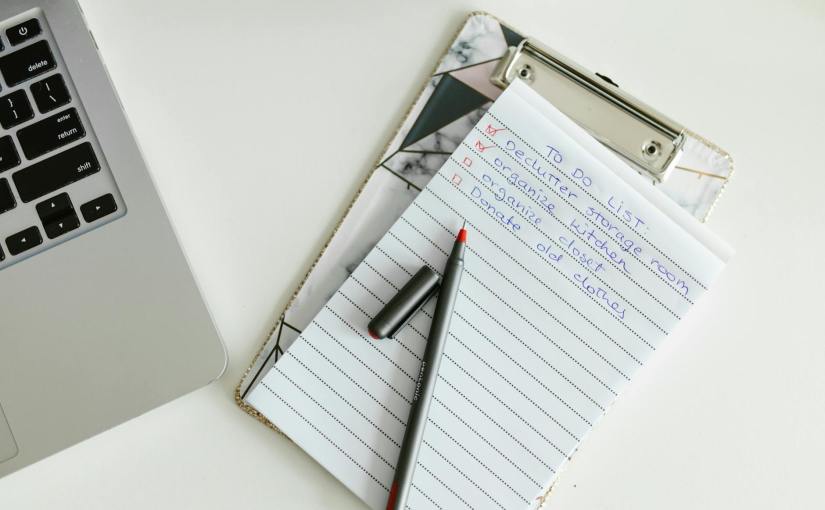
I am composing a list of revisions that need to be made in my manuscript, now titled Our Little Secret. Action items range from rewriting entire sections to a new point-of-view to perusing the menu of a local seafood restaurant and seeing what dishes the characters would order on their visit there. That list is what I plan to accomplish during the next month.

Committing it to paper is one way I make sure each item gets accomplished. I can check them off as completed. If needed, I can add new action items to the list.

I am a list-maker by nature. Helps me keep organized.

Wish me luck!

What Happens When You Try to Force Things to Happen

Back last year in the wake of getting a contract for Looking for Home (that was sadly cancelled), I decided to go ahead and start on Book #3. I wanted to revise another old manuscript, so I pulled it out and reread it.

While reading, I realized it was such a fundamentally different kind of book than Hurricane Baby and Looking for Home. Southern, yes, but only Southern because it was set in Mississippi. The theme of the book was very different from the other two; it was a very contemporary story as well. No deep, dark, past secrets to explore, etc.

So I wondered if I needed to work to make it more Southern, more gothic, and more spooky. I decided I did. I went to work on the POV, the setting, the chain of events. I introduced a supernatural aspect to the book; I changed the fundamental theme; I changed the struggles of the characters drastically.

And a voice in the back of my mind kept telling me that it wasn’t going to work this way.

But I ignored it. For months.

I probably wrote fifty pages of new material. I started a new document in my computer called RANT just to dump all the angst I was having doing this work–talking about what I wanted to do but talking about how much trouble I was having doing it, too. I thought I was just suffering from writers’ block again.

After not fooling with it for the past three months while I wondered what I was going to do with my creative life and after taking the initiative to cut about two-thirds of the material, I now realize I was just trying to force a new vision on a book out of fear. I had wondered if I built a fanbase on historical fiction if I could pull off a move to something more contemporary. Wondered if what I had tried to do then would work for the market now.

I finally realized I was just trying to make the story something it wasn’t.

Each story is its own creation. I was not the same writer I was back in the late 2000s, but that didn’t mean that every book I wrote had to do what I had done in revising Hurricane Baby, either. I was allowed to write whatever I wanted to write. And if I wanted to still do a story exploring those themes that were issues in the 2000s, that was fine. Did that mean I could do it differently to account for changes in society? Yes. But it did not mean I needed to chase a “brand” at this stage of my writing life.

If the story wants to be something different than what you normally write, let it. That’s how you grow as a writer. Challenging yourself to do something you haven’t done before.

Book #3 (which I’m currently calling Our Little Secret as a working title) is going to be different from the other two. And now that I’ve accepted that, I feel excited to work on it again. Don’t write scared. That’s the takeway.

Happy writing!

Stripping the Work Down to Basics

So I have actually been thinking about Book #3 quite a bit lately. (I know. I know. I said I wouldn’t work on anything until Looking for Home sold. I also reserved the right to change my mind.)

On Friday night while I was out of town, I remembered one of the guiding principles I used when revising Hurricane Baby–cut all the boring parts! For this rough draft, I figured out that meant to cut every part of the book where the two main characters weren’t directly interacting with each other.

Well.

I set to doing that this afternoon after we got back from the conference.

And that process cut the manuscript from 321 pages to 115.

Yikes.

While doing it, I realized that much of what I was cutting was extremely wordy setup for the next interactions between these two main characters. I was using a lot of words/dialogue/description/character thoughts to explain everything that was happening behind the scenes–then summarizing all that action in the next encounter between these two main characters.

So. What’s next?

I’m going to let it sit for a week or so–until April 1. Then I’m going to go back and re-read the stripped-down version, looking for what may need to be done to further develop their relationship. Because their relationship is where the heat is, the smoke. The action.

So we will see what happens.

Decision Time

So since I hate indecision more than anything, I’m making the decision that feels the most right for me right now.

I’m not going to work on another longform fiction manuscript until Looking for Home sells or I exhaust all avenues to get it traditionally published.

I’ve been trying to work on What Lies Ahead in fits and starts ever since the beginning of January after I got word that my deal for Looking for Home was cancelled. And that has been really painful and stressful for me. I’m sure you can imagine the stress–the primary thought that goes through my head at this point is WHY BOTHER?

I know all the very good reasons to bother writing–I enjoy it, it’s fun for me, I can’t know if it will be good or not until I actually write it, etc., etc.

But I also need to take care of myself and my own mental health. And right now, writing a longform fiction manuscript is neither enjoyable nor fun. I need to be in a place where I can regain my perspective on why I write and where I know that I am not hurting myself with my process or my words.

This is the pattern I took once I finished Hurricane Baby: Stories and started shopping it. I did not begin work rewriting Looking for Home until I got the offer from Madville Publishing for that first book. Currently Looking for Home has 12 rejections and is still out to 19 publishers, with plans to send to 10 more presses.

So we will see what happens.

I will continue to post here weekly about different thoughts on writing, my adventures in book events, craft articles, what it’s like being a debut author still, etc. I also have my Substack I also plan to continue posting on once a week about what helped make me a writer in the first place.

So I’m not stopping writing altogether. Just stepping back a bit. Please continue to visit and drop a note in the comments when you feel led with encouragement, questions, or requests for information about my upcoming schedule or my availability for any event. Thanks for understanding!

Keeping Records

I watched a college baseball game this weekend and marveled yet again at how absolutely every action on a baseball field is recorded and quantified for the record books–every ball, strike, error, hit, at-bat, catch–every movement has a statistic associated with it. It’s one of my favorite things about the sport–no action ever goes unnoticed.

(Did you know it’s possible to get no hits in a baseball game against the pitcher and still win? It’s happened once in MLB–on April 23, 1964, Ken Johnson of the Houston Colt .45s became the first pitcher to throw a nine-inning no-hitter and lose. In fact, he is still the only individual to throw an official nine-inning no-hitter and lose. The one run was scored on two fielding errors, a stolen base, one ground-out, and one fly-out.)

What does this have to do with writing?

I like to keep records of my writing life. I keep up with daily word count when I’m actively writing. I make lists of what scenes I want to revise when I need to work on a draft. I make lists of what presses I have sent manuscripts to and when and note when I hear back from them.

That tendency comes in handy for two reasons: 1) keeps me from going back over my tracks so I don’t send to the same publishing company twice, etc. and 2) gives me a sense of accomplishment in a trade that so rarely scratches the itch I have to feel like I am accomplishing ANYTHING.

I am wondering though if this recordkeeping is adding to my anxiety around writing, though. I try not to have word count goals, but I definitely set deadlines in my head to be at a certain point by a certain day on the calendar, etc. And I have definitely let myself get incredibly anxious about missing a self-imposed deadline or letting a few days go by without racking up words.

Anyone else have ideas or opinions around such quantifying of writing or any other creative endeavor? I am just trying to sort it out for myself but would appreciate others’ perspectives as well. Drop any insight into the comment section if you would–I’d appreciate it!

Happy writing!

The Land of Ice

So we are just a little too far south in Mississippi for the ice storm as of right now. No telling what’s going to happen in the next twenty-four hours, though.

I was envisioning myself shut up in the house with nothing to do.

Then I remembered the last time I was without power for an extended period–August 2005 after Hurricane Katrina blew through.

An idea for a story hit me a day or so after the impact.

I got out a pen and a spiral-bound notebook. I wrote a story of heartbreak, pain, and decisions with far-reaching consequences, created in longhand on real paper with real ink in moments between caring for my family and watching society crumble into exchanges of gunfire over the last bag of ice at the gas stations.

Those scribbles eventually became the opening story of my 2024 book, Hurricane Baby.

I still have pens, pencils, the ability to write in longhand, and over twenty empty paper journals people have given me over the past twenty years.

I’m going to be fine.

Getting it Right

I’ve talked before about my mantra for writing, no matter what kind it is: get it right and tell the truth. Those can be slippery concepts for fiction. Nonfiction can be easier–depending on what it is you’re trying to tell the truth about, such as in memoir, where truth can often be an elusive concept.

I’ve not always been good at telling the truth in my life. But eventually I learned that lying burdens the brain because you’re always having to think harder to keep your story straight.

The other prong of it I got to thinking about recently as I did some neurological testing to see what might be causing my memory issues or if it was just normal aging. It turned out that I am functioning fine for someone my age. But the doctor did note some interesting findings–one of which was that during the testing, I emphasized doing a task correctly rather than doing it quickly.

Ah, here was a question with a clear answer from my life! I told him that was an easy one to solve; in school, I used to be the first one in class to finish tests, but I didn’t always make a perfect score. So my mom impressed on me that I only got credit for getting the right answers, not for turning the paper in quickly. So all my life, I’ve been oriented to getting right answers and doing something correctly rather than quickly.

Back in my day, some teachers would go over the answers to a test by calling on people who got the question incorrect to give their answer so the teacher could explain why their answer was wrong. The first time that happened to me, I wanted to sink down through the floor in shame. That experience stuck with me my whole life–so I try as much as possible to get the details right in whatever I’m writing.

All of this, of course, can stop creativity in its tracks. The trick I use is to write about what I know I can get right first–then fill in the blanks with research and expert opinion. At least that’s the goal.

How do you approach truth in writing? Let us know in the comments!

Meeting the Moment

I’ve started wondering what exactly I need to be writing about.

I’ve got a novel idea that excited me for a while.

But the wackier this country is getting, the more I wonder if I need to be using my voice, small as it is, to do more than just fret about that.

I was schooled on the idea of journalists as objective observers of the actions of the body politic–good, bad, or indifferent. I tried to embody that in my writing, giving readers facts to let them make their own conclusions. This tack was pretty easy when I was doing features coverage: who, what, when, where, why, and how pretty much covered it.

Then I got into investigative reporting on mental health issues in my state–a topic very close to home given my diagnosis of bipolar disorder. I wrote and wrote and wrote–exposed, exposed, and exposed–and exactly nothing changed in practical terms. A few new laws got passed about training more people and setting up a new task force to replace the last task force, but that was all.

And I got burned out.

I could not see how someone involved in mental health matters could have read my work and not come away with a resolve to do what they could to change matters. But it seems they could.

I had been raising awareness for almost twenty years. I was tired of raising awareness. I wanted action. And it wasn’t forthcoming.

Now this country is on a collision course with history. I’m in the catbird seat to watch it–older, wiser, jaded, smart enough to able to see clearly through the smoke and mirrors, and seriously wondering where all my ideals went.

If we are no longer a free society, then what are we?

I’ve skated through life being comfortable with my political ideology as a moderate–suspicious of extremists of any flavor. I still feel that people can be trusted to make good decisions when given all the facts. But the very concept of what constitutes a fact is under attack from every conceivable direction these days.

What should we, as writers, do? It no longer seems to matter if we expose corruption as there’s no guarantee it will ever be prosecuted. No one seems to be interested in reading or hearing about government malfeasance unless the content already fits their own narrative.

I believe the answer is to write anyway. At least you can go to bed and sleep soundly, knowing you did your part.

I don’t know what this means for me yet. But I’m ready to find out.
Mississippi Book Festival 2025

I went again to this year’s book festival and had a wonderful time–I met MJ there and we walked around saying hello to everyone I knew. I also met several new people that I had not before, like the folks in charge of the Mississippi Institute of Arts and Letters, the University of Southern Mississippi Creative Writing program, the future Greenfield Residency program, and the Hancock County Library programs. Really neat organizations that I hope can continue on even as support for the arts is dwindling here.

I’m feeling at loose ends. My enthusiasm for my new manuscript suddenly disappeared last week. It was very disturbing. And I’m not quite able to figure out how to find it again. I may just have to do some for-my-eyes-only writing to figure out my why and what I actually want to do with the project. I may wait until I sell my current manuscript to start back on it in earnest since the energy is not there at this point. We will see.

But one of the sessions yesterday was very illuminating on what may have happened–the moderator, Steve Almond, said that you need to write what you’re obsessed about. When I first wrote the manuscript, I had an obsession–to explore the relationship between these two characters and see where it would go. But now I’m turning it into a very different book–about how the female lead overcomes when her life suddenly falls apart. I need to figure out why readers should care about this character. So I think that’s where I’m going to direct my efforts.

Happy writing, everybody!

Rest

Rest. That’s what I tried doing this week after I finished this third draft. I mostly succeeded.

I read. Some nights I went to bed early. Other nights I participated in chats with friends.

One night I wrote out a very basic note on the plot of the chapter that I’m adding to the middle section. I plan to start on that tomorrow night and hopefully finish a good draft within a week.

But I can tell I’m getting close to done with the writing of this book.

How do I know? I’m not thinking about the characters all the time. The impetus to rush to the computer and type on the draft has lessened. I’m starting to turn my mind to what comes next–another go-around of edits, perfecting a few more places I already know need work, making sure all the little details get cleaned up in preparation for going out to the wide world of querying.

Hopefully I can have a few days to sit with the manuscript at the end of July and marvel that I managed to do it again. A whole other book. YAY!